
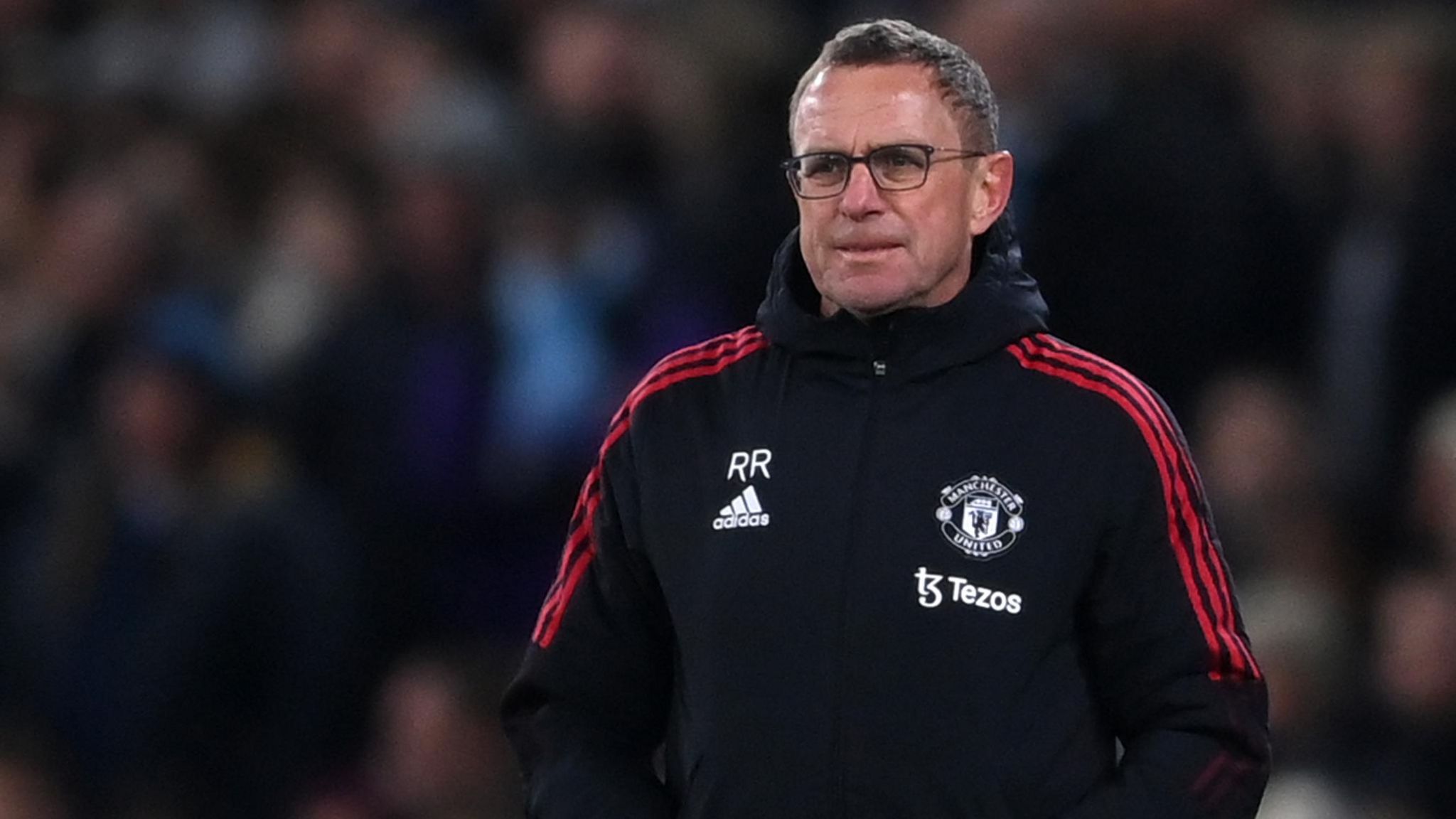

In each instalment The Devils in the Detail we’ll be breaking down one key detail, statistic, or piece of analysis – discussing why it’s important, its effect on United and what the Reds can do to address it.
After a truly awful showing away at Goodison Park, one of the most-discussed statistics that’s come to light this week is Ralf Rangnick’s woeful win percentage. Take a look below at how he compares to other managers who have taken charge of the team since – and including – Sir Alex Ferguson. (Stats via Opta)
| MANAGER | WIN PERCENTAGE (%) |
| Sir Alex Ferguson | 65.19 |
| Jose Mourinho | 58.33 |
| Ole Gunnar Solskjaer | 54.17 |
| David Moyes | 52.94 |
| Louis van Gaal | 52.43 |
| Ralf Rangnick | 40.9 |
Why is this important?
Perhaps a manager’s win percentage is a bit of a general, ‘broad strokes’ type statistic – but it’s been a huge talking point this week and demonstrates the wider malaise at United.
The drawback – or not, depending on your view – of the statistic is that it seems to implicitly lay the blame at Ralf’s feet. But does that seem fair at this point? There’s a squad that has let down a wide array of top flight managers too.
So yes, both the manager and the players must accept some culpability, but the club’s long term rot can’t be laid entirely with them.
Ultimately, as most reds have come to realise, United’s failings often hinge on what’s going on at the very top of the club, with the board, the Glazers and their employees.
The steady slide towards mediocrity is demonstrated by those tumbling win percentages and tied up in financial mismanagement and awful decision making.
“You cannot rely on this team of jokers that are not playing for the caretaker manager, having not played for the previous manager, having not played for the previous manager to that.”
Journalist and football analyst John Brewin offered his brutal assessment to listeners of The Guardian Football Weekly
Beyond brutality though, Brewin also offered some real insight and a long-term view of United’s issues, considering the changing attitudes at the club and its slap-dash finances, at some length.
“Now, one thing that’s been doing the rounds a lot from United fans is that there was a defeat two years ago or so, they were beaten heavily at Everton and Ole Gunnar Solskjaer said [something like] ‘Oh this is the worst ever and some of these players have got to be shipped out’. Now, I think many of those players were still involved in this game and that’s to do with two things: One of them is that United keep signing up these players to extend their contracts and the other thing is about how hard it is to break up a team these days because of the wages that clubs pay – particularly Manchester United.
So, the knee jerk reaction of any United fan is ‘clear them all out, play the kids!’ but you can’t do that in modern football anymore because there are players that are on – and I was hearing the other day from a relative of one of the players about this – a sum I could not quite believe.
I can’t say who it is, but what I can say is that they were on a ludicrous amount of money so that anyone who perhaps wanted to engage their services would be paying out an enormous amount of money for a player who is a bit talented but has had a bit of a bad season.”
John Brewin on The Guardian Football Weekly
Brewin contends that any new manager will be constrained by this financial mismanagement and it’s clear to see that the issue has dogged United over the last few years.
“It’s not impossible, of course. It’s possible [for a new manager] to make it better but I think one of the issues you’ve got of course is that – when you look at the way the Ten Hag negotiations have gone, and this is how it’s reported and this is what I understand – is that ultimately the decisions go down to the Glazer family. In American corporate structures, such as they are, the boss man makes the decisions and they don’t really delegate. They have a lot of people that may advise them and they don’t really listen to what’s being said.
So a lot of the decisions that have been made over the last year – maybe all of those decisions – Ronaldo coming back to the club, Ole getting sacked, Ralf Rangnick coming in to be an advisor who they don’t really listen to. All that type of thing, that comes from the top of the club, that comes from the Glazer family. It’s the view of me and most of the Manchester United fans that I know that things won’t change until they’re gone.”
Brewin continued on the podcast
So yes, the managerial win percentage is important, but it’s also important not to use it simply to pin blame on the manager. Instead, let’s question what tools and conditions these managers were given to do their jobs. Manchester United manager’s have been finding themselves in increasingly compromised positions, especially in the cases of Solskjaer – a relatively inexperienced manager, unlikely to make demands of the board and owners – and Ralf Rangnick – an interim manager.
How does it affect United?
Has financial mismanagement left us with a crop of increasingly rich and disenfranchised players? Players that see United as a destination, rather than a place to prove themselves? The weekend’s showing certainly fell in line with that theory. Performances and squad disharmony also suggest that there’s more at fault than just Ralf Rangnick, despite that damning and oft-discussed win percentage.
On Saturday, at Goodison Park, United played probably the league’s second worst team on current form, but it was an important fixture for both teams. United desperately needed to stay within touching distance of fourth place and Champions League football, without which it will be hard to attract the players required for a much-needed rebuild.
But the incentive of Champions League football and the advantage of playing a struggling Everton side weren’t enough. United slipped to a 1-0 defeat and did so with a whimper.
As Manchester United fans were painfully reminded on Match of the Day, Only Bruno Fernandes appeared in the top five players for ‘distance covered’ in the match. He was second, running 11.3km, just behind Alex Iwobi’s 11.5km and in front of Gordon, Allan and Richarlison. No Manchester United players appeared in the top five for ‘sprints’.
Elsewhere an ageing Matic understandably played ahead of the eye-wateringly expensive World Cup winner in Paul Pogba, thanks to Pogba’s lack-lustre performances and desire to leave the club. Then £50m right back, Aaron Wan Bissaka jogged back half-heartedly as Richarlison steamed down the wing, leading to the Everton goal. Of course, that goal deflected in off £80m centre back, Harry Maguire, who seems a shadow of the man we saw lead the England back line in the Euros. It’s a sad state of affairs.
What’s the solution?
Many members of United’s squad would have moved on – or been moved on – were it not for the club’s slap-dash approach to managing contracts, signings and wages. That same approach led to Rangnick’s appointment as an interim manager, when a permanent appointment was needed. It also left him with a disjointed squad, divided by wage disparities and varying levels of commitment to the club.
Consider arch-rivals Liverpool, who are currently locked in a battle to keep their best player, Mo Salah, because they don’t want to compromise the club’s wage structure. As much as it hurts to give them credit for anything, we should give them credit for clinging onto this morsel of principle in the increasingly unprincipled space that is football finance. Had United done so, it’s unlikely the club would have suffered so many fraught and unrewarding relationships with the likes of Paul Pogba and Mino Raiola.
Of course the solution is more financial responsibility and a team built with more of a plan and structure in mind, as well as a wage structure that doesn’t compromise the club’s ability to move players when needed and replace them. All of this seems a long way off while the club is still under the management of the Glazers, but hopefully a strong experienced manager like Erik Ten Hag will be able to wrest back some control over transfer policy at the very least. As far as ownership and long term solutions are concerned, United fans will have to hope that on-going protests can make fans voices heard.