
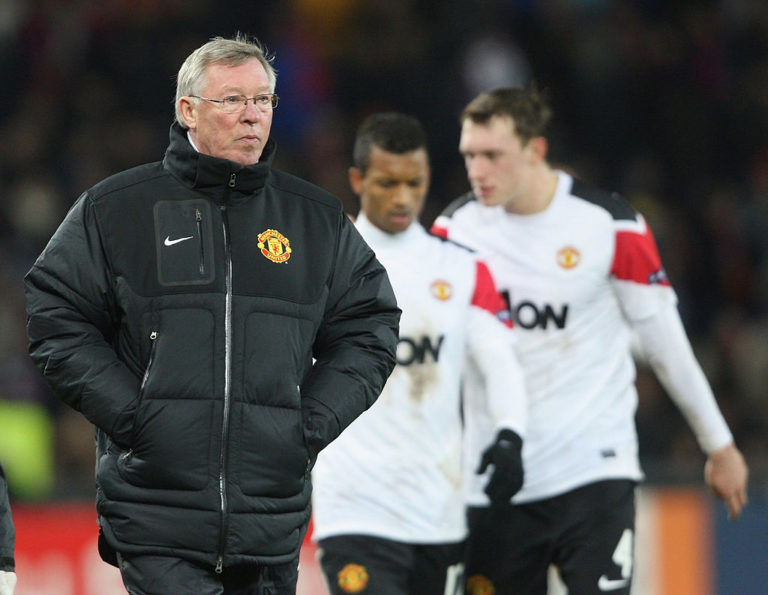

On the 28th May 2011, Manchester United were completely humbled by an incredible Barcelona side at Wembley Stadium in the 19th Champions League final. United’s dominant side that Sir Alex Ferguson had established in the late 2000s that had won four league titles in five seasons and had reached three Champions League finals in four seasons was now slowly starting to crumble. Unlike in the 2008/09 season, where United almost defended their European crown after reaching the final for a second consecutive season. The 2011/12 Champions League campaign was a low for United under the Sir Alex era, the miserable Europa League campaign that followed was even worse.
Going into United’s 16th consecutive season in Europe’s elite competition, it was expected that at the bare minimum a squad that contained Wayne Rooney, Michael Carrick, Rio Ferdinand and Nani reached the knockout stages. A favourable group that contained Benfica, Basel and Romanian champions Oțelul Galați, shouldn’t have posed any problems for a team that had reached the final the previous season.
Despite two disappointing draws to Benfica and Basel in the first two games of the group, United ended up with eight points after four games when Galați were seen off comfortably 2-0 at the Oțelul Stadium and at Old Trafford by the same scoreline. All United had to do was win one of their last two games either at home to Benfica or away in Basel and they would be through to the knockout stages. The two wins against Galați had put United top of the group and with United unbeaten in ten at home against Portuguese sides, there was an expectation that Benfica wouldn’t end that run.
When Phil Jones, however, scored an own goal inside the first three minutes, the game had been completely turned on its head. Dimitar Berbatov and Darren Fletcher restored the lead for United but just two minutes after Fletcher had made it 2-1, Pablo Aimar had brought the game level again. David De Gea gifted Benfica the ball just outside the United box after a poor kick and it gave the Portuguese side the perfect chance to equalise. Despite late chances for both sides, the match finished 2-2.
This was still an okay result for United. Sure, it wasn’t exactly ideal. A win would’ve guaranteed a spot in the knockout stages of the competition and Ferguson could have been able to rest a few of his players for the last game of the group in Switzerland, which would keep his side fit for a highly competitive title-race. United could still qualify though. All they had to do was match Benfica’s score against Galați to go through as winners of the group. A draw would put United in second and despite maybe a tougher draw compared to if they finished as winners, Ferguson would still have his side in the knockout stages.
All United had to do was draw against Basel.
Basel.
Just like against Benfica, United conceded an early goal inside the first ten minutes after more clumsy defending from De Gea and the United defence. Xherdan Shaqiri sent in a low cross that shouldn’t have been a problem for De Gea but his inexperience at that time caught up with him as he poked the ball away straight into the path of Marco Streller, who tapped home to give Basel the lead.
This was only ten minutes in and United surely could muster up something to at least get a draw to go through, right?
Nope.
Six minutes from time, more poor defending from United knocked them out of the competition. Shaqiri whipped in another cross and Smalling decided that he wasn’t going to bother picking up on Alexander Frei behind him and just stood still whilst Frei snuck in behind him to score a diving header and knock United out of the competition. The campaign had been a disaster. A late goal from Jones had been mere constellation for what had been an abysmal performance.
 United didn’t deserve to go through. It had been a tepid performance against a side that had a few decent players but really shouldn’t have posed any problems. United never created any decent chances and never showed any urgency. The punishment for such a performance would be more European football in the form of the Europa League. In the space of several months, United had gone from playing Barcelona on primetime ITV in the final of the Champions League to a competition that they really didn’t want to be in that was shown on Channel 5.
Still, United hadn’t played in the competition since 1996 and maybe it would be a chance for some of the young players in the squad at the time such as Paul Pogba and Zeki Fryers to gain valuable first-team action whilst playing a part in leading the club to its first-ever title in the tournament.
The Europa League though had never been fair to United throughout its history. The last time United played in the competition, Rotor Volgograd had caused an upset by knocking out United at home on away goals. There had been more upsets as well in the past to the likes of Torpedo Moscow and Videoton. The last time United won a tie in the competition was in 1985.
The squad at the time might have been fighting for a fourth league title in five seasons but that wasn’t going to necessarily equate to success in a tournament that was often unforgiving and difficult to understand compared to the Champions League. The past four winners of the Europa League leading up to the 2011/12 season had been from Portugal, Spain, Ukraine and Russia. This was unpredictable by UEFA’s standards compared to the two Champions League’s picked up by Barcelona in that time where two of the finals had been the same teams against each other.
For all the talk of United being humiliated by having to play the IKEA catalogue sounding names on Thursday nights, It would be a genuine heavyweight of European football in Ajax, that would host Old Trafford’s first Europa League game in 16 years. The Dutch champions at the time had also exited the Champions League at the group stages and had dropped into the competition.
The first leg at the Amsterdam ArenA would be a litmus test for Ferguson to see where his side was after the embarrassment that had occurred several months earlier in Switzerland. Like most Ajax sides, there was some decent young talent in the squad at the time such as Christian Eriksen, Toby Alderweireld and Jan Vertonghen. If United were going to take this competition as seriously as they were saying at the time, then this would be a good tie to showcase that.
What played out was a very thorough and professional performance. It was how you would expect United to go about getting results in Europe under Ferguson. Sure, this wasn’t the Ajax under Rinus Michels that had Johan Cruyff and Johan Neeskens but they were still very capable of punishing United if they wanted to.
Goals from Ashley Young and Javier Hernández in the second half ended up giving United a comfortable 2-0 lead going into the second leg. United still hadn’t quite been at their best but they’d controlled the game well and had given themselves a good position for the second leg back at Old Trafford.
The second leg, however, would mirror United’s performances at home in the Champions League. A nervous 2-1 defeat saw United go through on away goals but if it wasn’t for the convincing win in the first leg, Ajax would have gone through. Hernandez gave United the lead early on but Aras Ozbiliz and Alderweireld put Ajax in front. De Gea kept United in the tie after an amazing save from a Siem de Jong header, Ajax could’ve won the game quite convincingly if they took their chances. It was the Benfica game all over again.
Athletic Club would be the next side that United would face in the round of 16. This would be a much harder test than Ajax as this was a side that was managed by Marcelo Bielsa that was playing some pretty incredible football at times over in Bilbao. ‘El Loco’ had guided his side to only three defeats in 21 games and at the time of playing United, were one point from the Champions League spots and had secured a spot in the final of the Copa Del Rey.
Bielsa was extremely intense with his side and it had worked wonders for him. Like we saw when he came to Leeds last season, he had watched every Athletic game the previous season, noting down everything he found on colour-coded spreadsheets. Bielsa’s video sessions apparently sometimes went on for up to five hours and he didn’t leave the office until the early hours of the morning the next day.
Bielsa would have United’s weaknesses ingrained inside his brain and would know exactly where to pinpoint the problems in the side. What ended up playing out in the first-leg at Old Trafford, was the best performance by European side there in the 2010s.
Athletic Club had changed their style from their traditional English style of play when Bielsa took over. They had changed to a more possession-based style with more shots at goal. Bielsa’s side had more of the ball, more goals and more shots than anyone else in La Liga apart from Real Madrid and Barcelona in the 2011/12 campaign. Future United cult hero Ander Herrera, was the main part of a midfield that liked to dictate the play. The aggressiveness of Bielsa’s system was a huge shock to United.
Rooney scored an early goal for United to open the scoring but it was the side from the Basque Country that really took the game by the scruff of the neck. Fernando Llorente brought the game level just before half-time and the second half was a complete onslaught from the away side.
After David De Gea had kept United level somehow after a string of magnificent saves, United unsurprisingly went 2-1 down. Oscar De Marcos scored on the half-volley after a neat little chip pass through the United defence from Herrera. It genuinely could’ve been four or five at this point. Bielsa had set up his side to be so relentless that they were just creating chance after chance, the flimsy United defence was letting them in behind constantly.
Iker Muniain added a third on 72 minutes despite De Gea’s best efforts and United had now been humiliated at home, on Channel 5. Rooney brought United some hope for the second leg with a penalty in added time, but 3-2 wasn’t a fair reflection of the game. It could’ve easily been 5-1 if Athletic Club had taken their chances.
The second leg at San Mames mirrored the first leg for United. Once again, Bielsa’s side completely outclassed United. The high press all over the pitch, the neat passes from Herrera and the sheer arrogance of Bielsa to set up his side like this to play United worked wonders for him. Goals from De Marcos and Llorente put United out of their misery and sent Athletic Club through after another convincing 2-1 win.

The 2011/12 European campaign for United had been a complete disaster. An easy group that shouldn’t have posed any problems ended in embarrassment in Switzerland and the Europa League campaign that followed was even worse.
The point behind this is that sometimes as football supporters, we can get blinded by nostalgia. Sure, the football was better under Ferguson at times than it has been over the past five years but we didn’t win every game. United still took time to rebuild squads and success wasn’t just given to Ferguson on a plate. He still made mistakes as a manager as we saw against Athletic Club.
As for Bielsa’s side, he completely burnt them out before the season had finished. Athletic Club did reach the Europa League final but lost to Atlético Madrid. There wasn’t any luck in the Copa Del Rey final either as Barcelona won that quite convincingly 4-1. As for that Champions League spot, they ended up finishing tenth in La Liga. The win against United was as good as it got for that specific Athletic Club side as the following season, Bielsa left.
Related posts:
 Manchester United Women: 2025/26 Season Preview
 Manchester United vs Brentford: The Preview
 Manchester United 3-2 Burnley: Bruno Fernandes Saves The Reds Once Again
 United vs West Ham – The Preview
 Manchester United vs Newcastle United: The Preview
 Manchester United 1-0 Newcastle United: Dorgu’s stunner seals the three points
 Newcastle United vs Manchester United: The Preview
 Chelsea vs Manchester United: The Preview
 Mount in Midfield: Is United’s Answer Already at Old Trafford?